
“The true measure of any society can be found in how it treats its most vulnerable members.” – Mahatma Ghandi
Nestled in the heart of Nairobi, Deep Sea Informal Settlement is home to thousands of Kenyans striving to live in dignity under extraordinarily difficult conditions including but not limited to inadequate housing, sanitation challenges, poor drainage, limited access to emergency services, inadequate education facilities, insecurity and environmental degradation, all of which undermine the realization of the rights guaranteed under Article 43 of the Constitution of Kenya.
While the community has demonstrated remarkable resilience including securing a landmark court victory against forced evictions, its residents continue to face daily violations of their fundamental human rights. The right to adequate housing is about far more than having a roof over their head. It includes access to healthcare, safe water, sanitation, education, security, and a healthy environment. For many residents of the Deep Sea, these rights remain out of reach.
Health Is a Human Right, Not a Privilege.
Article 43 of the Constitution of Kenya guarantees every person the right to the highest attainable standard of health, including access to healthcare services. Yet, residents of Deep Sea Informal Settlement have no public health facility. Residents depend largely on private clinics, many of which are beyond the financial reach of the many low-income households in this community. In medical emergencies, the situation becomes even more alarming.
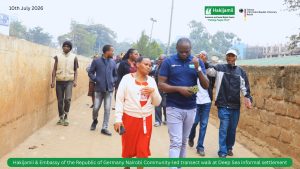
During Hakijamii’s recent community-led transect walk, residents described how ambulances cannot access most parts of the settlement because roads are too narrow and obstructed by unplanned structures. Critically ill patients including pregnant women, children, older persons, and persons with disabilities must often be carried by strong members of the community through narrow pathways before reaching the nearest accessible road. In emergencies, every minute matters, and these delays can mean the difference between life and death.
The Right to Water and Sanitation Remains Unfulfilled.
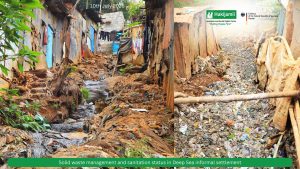
Access to clean water has improved in Deep Sea, but safe water alone cannot guarantee good health when sanitation systems are failing. The settlement faces severe sanitation and waste management challenges. Public toilets are privately managed and often close at night because of insecurity, forcing many residents to resort to unsafe practices such as the use of “flying toilets.” Waste is frequently disposed of in drainage channels and open spaces, while blocked drains and inadequate waste collection create ideal conditions for disease transmission.
Compounding the problem, garbage collection trucks cannot access many sections of the settlement due to poor road infrastructure. As waste accumulates, it pollutes the environm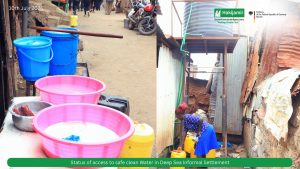 ent, contaminates drainage systems, and threatens the health of entire households particularly children, who are disproportionately exposed to preventable illnesses.
These conditions fall far short of Kenya’s constitutional obligations and international human rights standards, including the International Covenant on Economic, Social and Cultural Rights (ICESCR), which recognizes the rights to health, water, sanitation, and an adequate standard of living.
A Community Living Under Constant Disaster Risk.
Deep Sea is not only underserved, it is highly vulnerable. The settlement’s narrow pathways, overcrowded housing, and blocked drainage systems create a perfect environment for disasters. During the rainy season, flooding becomes commonplace as drainage channels overflow with solid waste. Floodwaters spread sewage and other contaminants, increasing the likelihood of outbreaks of waterborne and vector-borne diseases.
The dense concentration of homes constructed with highly combustible materials also make Deep Sea particularly vulnerable to fire outbreaks. With fire engines unable to access the interior of the settlement, a single fire can spread rapidly, destroying homes, livelihoods, and lives before emergency responders can intervene.
These are not merely environmental hazards, they are human rights concerns that expose communities to preventable suffering.
No Public School Means Unequal Opportunity.
Deep Sea also lacks a public primary and secondary school. Children are forced to cross busy roads to attend schools outside the settlement, exposing them to daily safety risks. Many families cannot afford private education, contributing to school dropouts, teenage pregnancies, unemployment, and increased vulnerability to crime and substance abuse.
The right to education cannot be realized when access itself becomes a daily hazard.
The Mumps Alert: A Warning We Cannot Ignore.
The Government of Kenya has recently heightened surveillance and public awareness following reports of increased mumps infections in parts of the country. While mumps is preventable through routine immunization, outbreaks spread more easily in overcrowded settings where people live in close proximity and where access to healthcare and hygiene services is limited.
Deep Sea embodies many of the conditions that can accelerate the transmission of communicable diseases: overcrowded housing, inadequate sanitation, poor waste management, limited healthcare access, and constrained emergency response. These structural inequalities increase the community’s vulnerability not only to mumps but also cholera, typhoid, hepatitis A, respiratory infections, and future disease outbreaks.
The current mumps alert should therefore serve as a wake-up call. Disease preparedness cannot rely solely on public health messaging; it must also address the social and environmental conditions that allow diseases to spread.
What Must We Do?
The challenges facing the Deep Sea are neither inevitable nor insurmountable. They require coordinated action by national and county governments, development partners, civil society, and the community itself.
Immediate priorities should include:
- Establishing a public health facility within or near the settlement.
- Investing in accessible roads that allow ambulances and fire engines to reach every household.
- Improving solid waste management and expanding sanitation infrastructure.
- Constructing a public primary school to ensure equitable access to education.
- Strengthening drainage systems and enhancing flood mitigation measures.
- Installing fire safety infrastructure and improving disaster preparedness.
- Protecting the constitutional rights of informal settlement residents through sustained investment in basic services.
Beyond Infrastructure: Restoring Dignity.
 The story of Deep Sea is ultimately not about inadequate infrastructure, it is about dignity, equality, and justice.
Every resident has the right to live in an environment where children can safely attend school, where mothers can reach healthcare during childbirth, where emergency services can save lives, and where clean surroundings protect families from preventable diseases.
The Constitution of Kenya promises these rights to all citizens. The Sustainable Development Goals call for inclusive, safe, resilient, and sustainable cities. The time has come to translate these commitments into meaningful action.
No Kenyan should have to risk illness, disaster, or death simply because of where they live.

